Woven vs. Embroidered Patches: The Technical Guide
But thread isn’t ink. It has physical thickness. It has limits.
I see it every day: someone tries to force a high-detail streetwear logo into an embroidery machine and they walk out with a fuzzy, unreadable blob. I’m here to make sure your brand doesn’t look like a mistake.
If you’re building a collection in the DTLA Fashion District, you need to understand the hardware. You’re choosing between a needle and a loom. They don’t play by the same rules.
The “10-Foot Rule”: Visual Impact vs. HD Detail
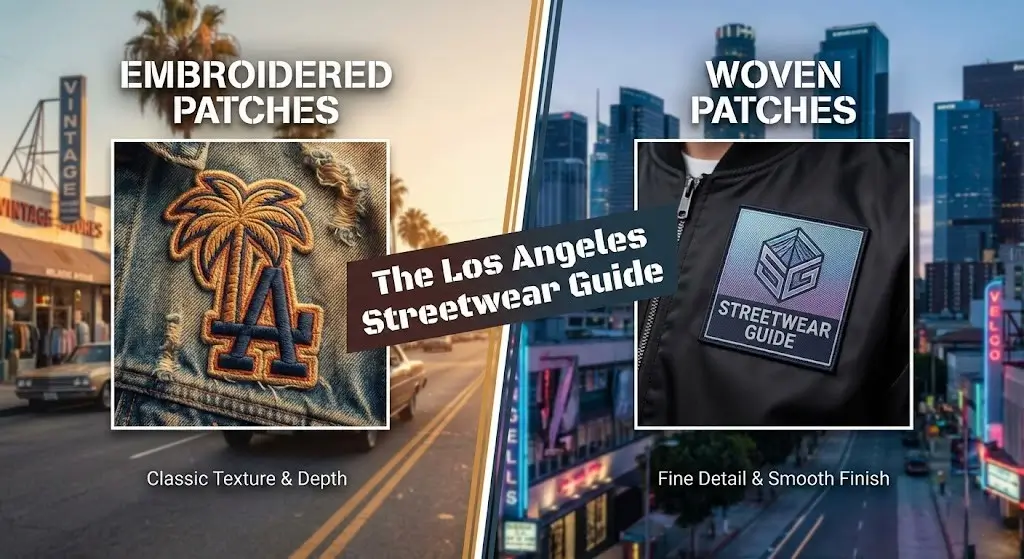
I tell my clients to use the 10-foot rule. Stand across the room. If you want people to recognize your logo from ten feet away, go with Embroidered. It has height. It has texture. It has that heavy, vintage soul you see on varsity jackets and classic workwear.
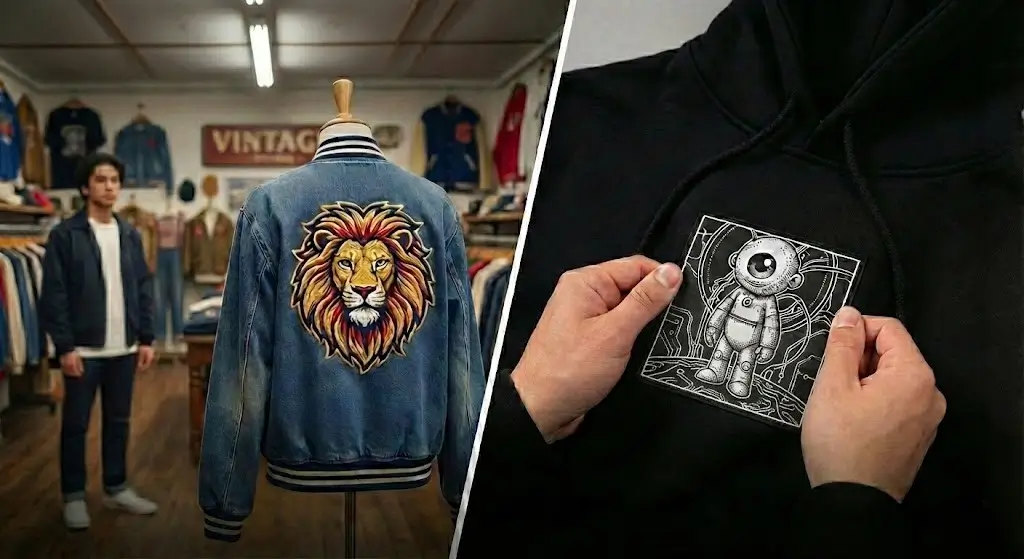
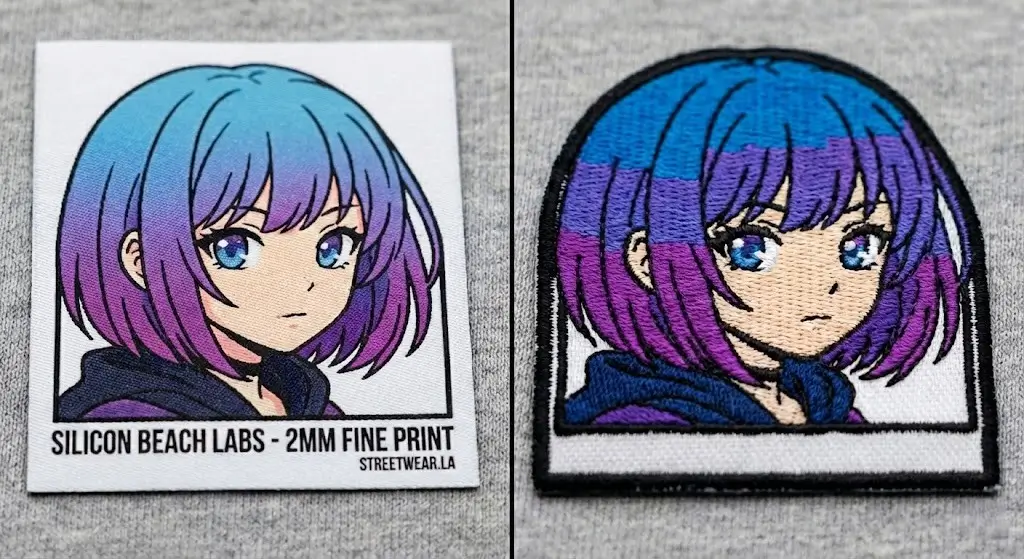
But if your customer is holding the hoodie in their hands and you want them to see the tiny pupil in a character’s eye or read a URL? You need Woven. We call it “High Fidelity.” Streetwear is moving toward this HD look. More detail. Less bulk.
The “Micro-Detail” Test: Why Streetwear Loves Woven
In Silicon Beach or Downtown, the logos are getting more complex. Embroidery can’t keep up.
The 3mm Limit
The thread is thick. When we stitch, the needle has to move. If your text is under 4mm, the loops of thread crash into each other. You get a mess. Woven patches stay crisp down to 2mm. You can actually read the fine print.
Gradients & Shading
Woven threads are ultra-thin, allowing us to blend them for shadows. However, for complex anime fades that require perfect color transitions, we often recommend photo-realistic printed patches as the ultimate solution for gradients.
The “Stiffness” Factor: Drape & Fit
This is where fashion designers mess up. They forget that a patch is a piece of hardware attached to a garment.
Embroidery = Armor
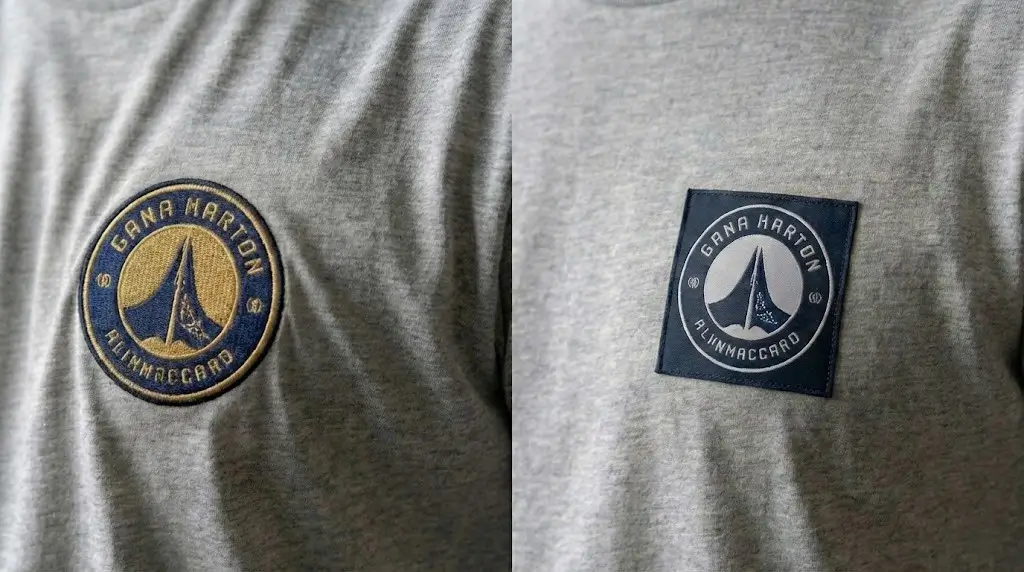
An embroidered patch is a layer of twill fabric plus a solid wall of polyester thread. It’s stiff. It’s heavy. On a heavy denim jacket, it’s fine. On a t-shirt or a lightweight hoodie? It sags the fabric. It makes the shirt “nipple.” It ruins the drape of the clothes.
Woven = Fabric
Woven patches are basically a piece of fabric themselves. They’re thin. They’re flexible. They move with the hoodie. They lay flat against the chest. If you want that high-end retail feel, you go woven.
The “Vibe” Check: Which Fits Your Collection?
Your manufacturing choice defines your brand’s era.
Choose Embroidery If…
You want “Heritage” or “Rugged.” Think Carhartt or Supreme box logos. It feels like “Old Money” sports. It’s the choice for Hollywood production crews who need a patch that looks official on camera.
Choose Woven If…
You want “Modern” or “Clean.” Think Kith or Palace. It’s for tech-wear and detailed graphic art. It looks like it was engineered, not just sewn.
The “Hybrid” Hack (Best of Both Worlds)
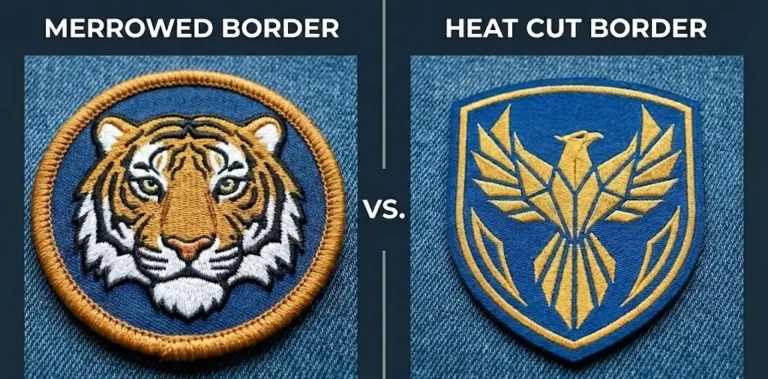
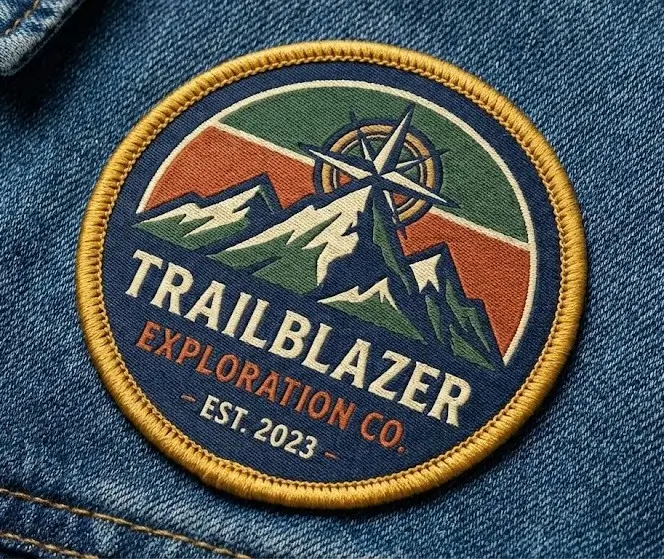
Here’s the secret we use on the floor. If you want the detail of a woven patch but the “premium” weight of embroidery, order a Woven Patch with a Merrowed Border.
You get the HD art in the middle, but we wrap a thick, embroidered frame around the edge. Read our guide on Merrowed vs. Heat Cut borders to see how this specific edge finish transforms a flat woven label into a premium patch.
Step into the back of the shop. If you want to make an informed decision, you need to see the guts of the machines. Most “middlemen” websites won’t tell you how this works because they’ve never actually touched a loom.
The Technical Guide to Thread Architecture
Here’s the industrial reality: embroidery and weaving are two completely different engineering processes. One is additive; the other is structural.
Manufacturing: Needle vs. Loom
We start with a base fabric—usually a polyester twill. We shoot a needle through it thousands of times. The thread sits on top of the fabric. This creates “loft.” It builds a 3D texture you can feel with your thumb. It’s heavy because it’s a fabric-on-fabric sandwich.
We use a high-speed loom. There is no base fabric. The vertical threads (warp) and horizontal threads (weft) interlace to create the patch and the design at the same time. It’s a single layer. It’s smooth. It’s continuous. It’s more like a piece of high-end silk than a traditional badge.
Thread Physics: Why Woven Holds Detail
It comes down to Denier. That’s just a fancy word for thread thickness.
Think of it like a Sharpie marker. It’s great for coloring in big shapes, but try writing a novel with a Sharpie, and it turns into a black smudge. That’s why embroidery kills fine detail.
We use 100 Denier Damask thread. It’s like a 0.5mm technical pen. Because the thread is so fine, we can pack it tighter. That’s how we get pixel-perfect resolution on those complex streetwear logos.
Durability & Washing
The threads are “looped” on the surface. If you’re wearing a backpack or a tactical vest, those loops can snag on zippers or gear.
If you’re making activewear or gear that’s going to take a beating at the Port of LA, woven is durable. But for gear exposed to saltwater and grease, we usually upgrade clients to heavy-duty PVC rubber which is impervious to the elements.
Cost Analysis for Brands
I’ll be straight with you on the math.
Embroidery is usually cheaper. Setting up a Tajima head is faster than threading a massive loom.
Woven wins on price. Looms run faster than embroidery needles. Once the loom is “warped” and ready to go, it spits out patches at twice the speed.
Frequently Asked Questions (The Blunt Version)
Application & Tech
Can I put an iron-on backing on both embroidered and woven patches?
Yes. But here’s the factory secret: Iron-on works better on Woven. Because woven patches are flat and thin, the heat penetrates the material faster to melt the glue. On a thick embroidered patch, the thread acts as an insulator. You have to press it longer, which risks scorching your fabric.
Style & Perception
Which patch style looks more ‘Premium’: Woven or Embroidered?
It depends on who you’re asking.
Embroidery looks premium to “Old Money” and heritage brands. It looks like a classic badge.
Woven looks premium to “New Money” and tech-wear brands. It looks like it was engineered in a lab.
Advanced Options
Can I mix Woven and Embroidered styles together?
You can’t weave and stitch in the same machine pass. It’s impossible. However, we do Mixed Media. We can take a woven label and sew it onto a garment, then run an embroidery border around it. It costs more because it’s a two-step process, but it looks Hollywood-ready.
| Feature | Embroidered Patch | Woven Patch |
|---|---|---|
| Texture | Heavy, 3D, Raised | Smooth, Flat, Lightweight |
| Resolution | Low (8-bit feel) | High (4K feel) |
| Smallest Text | 4mm (Minimum) | 2mm (Crisp) |
| Best For | Hats, Denim, Varsity Jackets | Hoodies, T-shirts, Tech-wear |
| LA Vibe | Heritage / Classic | DTLA Streetwear / Modern |
The Bottom Line:
If your logo has a lot of small text or gradients, don’t argue with the machine. Buy Woven. If you want that thick, “American Classic” feel and your logo is bold, stay with Embroidery.
Either way, we’ll make sure the tension is right, and the colors don’t bleed.
Get A Quote for Your Brand